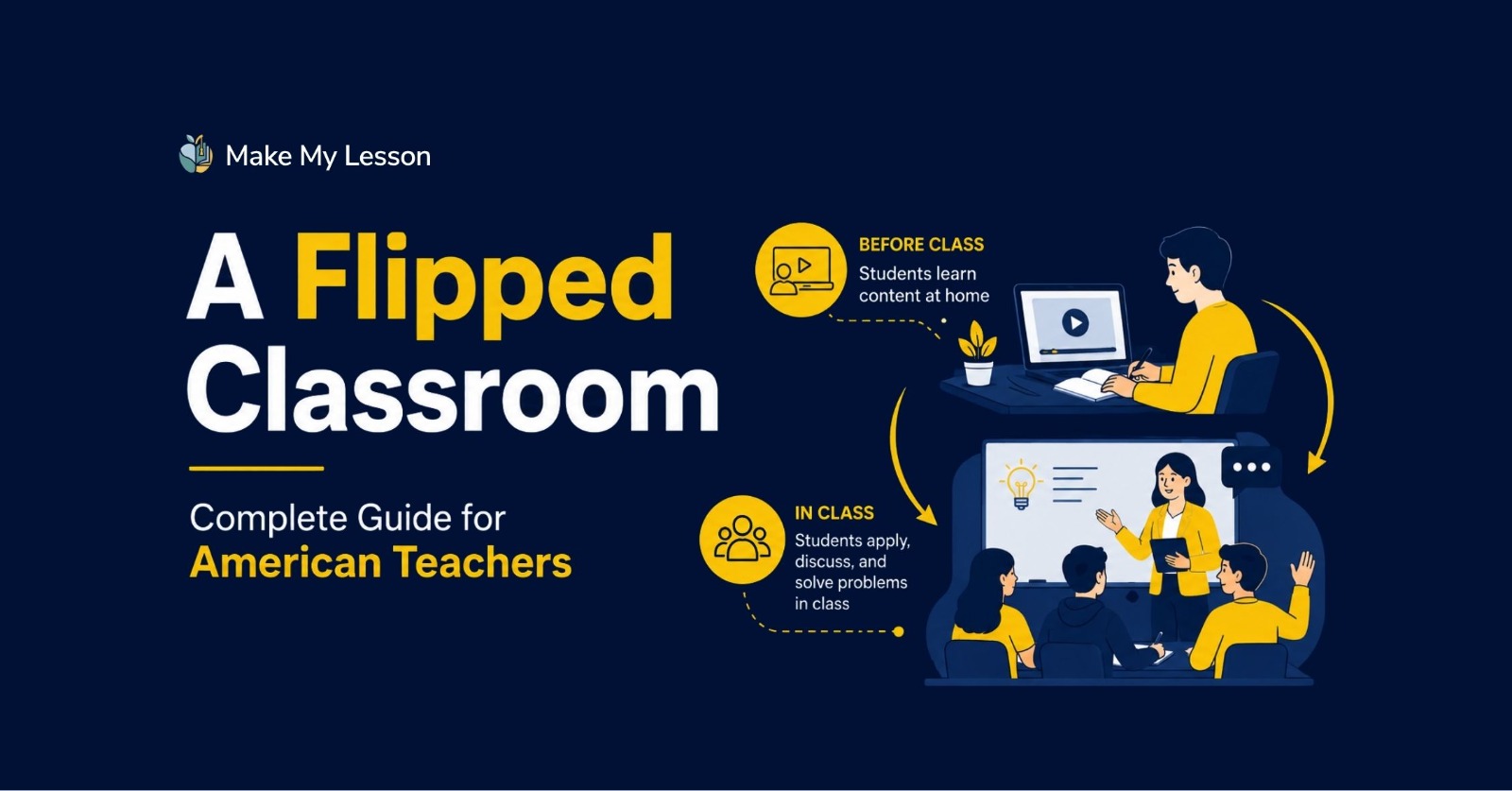
What is a flipped classroom? It's a teaching model that inverts the traditional sequence of instruction: rather than using class time for direct instruction and sending students home to practice independently, the flipped classroom model delivers instructional content before class — typically through video or pre-reading — and uses class time for the higher-order activities that previously had to be homework: discussion, problem-solving, application, collaboration, and teacher-guided practice. The idea is straightforward. The implementation — particularly the content creation it requires — is where most teachers who want to flip a classroom run into difficulty.
This blog explains the flipped classroom model in detail, covers its evidence base and its real-world limitations, and shows how Make My Lesson reduces the content creation burden that has historically prevented many interested teachers from making the flip.
The Traditional Classroom vs the Flipped Classroom Model
In the conventional classroom model, the structure is: teacher delivers new content during class time, students go home and practice that content independently for homework. The problem with this sequence has been well-documented: students encounter their greatest difficulty — the practice and application of new knowledge — at precisely the moment when the teacher is unavailable to help. Homework confusion goes unaddressed until the next day. Students who don't understand the concept are completing practice that reinforces misconceptions.
The flipped classroom model reverses this: students encounter new content before class — through an instructional video, a pre-reading task, an interactive module — and arrive in the classroom having already received the initial instruction. Class time then becomes available for the activities that benefit most from teacher presence: guided practice, collaborative problem-solving, discussion, Q&A, and differentiated support.
The core logic is compelling: the activities that require the teacher's expertise and responsiveness should happen when the teacher is in the room. The activities that don't require real-time teacher input — initial content delivery, which can be paused, rewound, and reviewed — can happen outside the classroom, freeing class time for what teachers do best.
What the Research Says About the Flipped Classroom
The research on flipped classroom effectiveness is generally positive but nuanced. Meta-analyses consistently show that flipped classrooms produce modest positive effects on student achievement compared to traditional instruction — with effect sizes typically in the range of 0.20 to 0.40. The most consistent benefits are reported in STEM subjects and at secondary and post-secondary levels, where the ability to revisit complex instructional content at one's own pace before class addresses a well-documented problem with traditional lecture delivery.
The research also identifies the conditions under which flipped learning works best: when the pre-class content is genuinely instructional and accessible (not just a textbook chapter or a long, undifferentiated lecture video), when class time is actively restructured to use the freed time for higher-order activities (not just more practice of the same type as traditional homework), and when students who don't complete the pre-class preparation have a structured in-class alternative that doesn't derail the rest of the lesson.
The Real Challenge of Flipping a Classroom: Content Creation
The most significant practical barrier to implementing a flipped classroom model for most teachers is the volume of content creation it requires. Traditional instruction repurposes existing materials — textbooks, existing presentations, previous lesson notes. A flipped classroom requires producing new pre-class instructional content that students can engage with independently, plus redesigning the in-class experience to use the freed time meaningfully.
For teachers who are already at or beyond their planning time capacity, adding a pre-class content creation workflow to their weekly preparation is often a dealbreaker — not because they don't value the model, but because the hours required to implement it consistently simply aren't available within a sustainable professional schedule.
Flipped Classroom Activities That Make the In-Class Time Count
Successfully flipping a classroom isn't just about what happens before class — it's equally about what happens during class time once direct instruction has been moved out of it. The most effective in-class flipped classroom activities are those that genuinely require teacher presence and benefit from the social and collaborative dynamic of the classroom:
• Socratic discussion: Teacher-facilitated discussion of the pre-class content's implications, applications, or connections to prior learning. Students who have watched the instructional video arrive with enough background knowledge to engage in genuine discussion rather than simply receiving information.
• Problem-solving workshops: Students work through challenging problems or case studies in groups, with the teacher circulating to provide targeted support. This is qualitatively different from independent homework practice because the teacher is present for the moment of difficulty.
• Peer teaching: Students who have solidly understood the pre-class content explain it to peers who struggled — which deepens understanding for both the teacher and the learner.
• Lab and application activities: In science, mathematics, and skills-based subjects, class time can be devoted to the hands-on application or experimentation that is difficult to do at home.
• Differentiated small group instruction: With students who have solid understanding working independently or collaboratively, the teacher has time to work intensively with those who need additional support — a form of in-class differentiation that is nearly impossible in a traditional lecture format.
These activities don't happen automatically just because the teacher has flipped the delivery of content. They require advance planning — which is where Make My Lesson provides direct support.
How Make My Lesson Supports the Flipped Classroom Model
Make My Lesson supports both components of a flipped classroom implementation: the pre-class content and the in-class activity design.
For the pre-class component, Make My Lesson can generate structured pre-reading guides, guided note-taking frameworks, and comprehension check activities that students complete while engaging with instructional video content. These materials help ensure that pre-class time is active rather than passive — students arrive having not just watched a video but having processed it through structured questions and note-taking prompts.
For the in-class component, Make My Lesson generates the full lesson plan for the in-class session — specifying the discussion protocols, collaborative tasks, differentiated small-group activities, and formative assessments that make use of the class time the flip has freed. A teacher doesn't need to separately design the video content and the in-class experience — Make My Lesson handles the planning infrastructure for both halves of the flipped lesson.
Frequently Asked Questions
What is a flipped classroom?
A flipped classroom is a teaching model in which the traditional sequence of instruction is inverted: students receive initial content instruction before class — typically through video lectures, pre-readings, or interactive modules — and class time is then used for higher-order activities that benefit from teacher presence, such as discussion, collaborative problem-solving, application tasks, and differentiated small-group instruction. The model is designed to ensure that the moments when students most need teacher support — during the application and practice of new knowledge — happen when the teacher is in the room.
What are the benefits of the flipped classroom model?
The flipped classroom model offers several potential benefits: students can review instructional content at their own pace before class, rewatching sections they find difficult; class time is freed for the more cognitively demanding activities — discussion, problem-solving, application — that produce deeper learning; teachers are available during the hardest parts of the learning process rather than during initial content delivery; and differentiated small-group instruction becomes more feasible when the teacher doesn't need to deliver the same content to all students simultaneously.
What are the challenges of implementing a flipped classroom?
The primary challenges include: increased content creation burden for teachers (pre-class instructional materials must be created in addition to in-class lesson planning); equity concerns for students without reliable internet access or home technology; managing students who don't complete pre-class preparation; and the need to genuinely redesign in-class time rather than just moving the lecture outside and keeping the same activities in class. Addressing these challenges requires planning support tools that reduce the creation burden and structured in-class activity designs that make the flipped time genuinely productive.
What flipped classroom activities work best in the classroom?
The most effective in-class flipped classroom activities are those that genuinely require teacher presence and benefit from peer collaboration: Socratic discussion of pre-class content, workshop-style problem solving with teacher support, peer teaching activities, hands-on lab or application work, and differentiated small-group instruction where the teacher works intensively with students needing additional support while others work collaboratively. These activities should be planned explicitly — the flipped class time doesn't fill itself productively without deliberate in-class activity design.
How does Make My Lesson help teachers flip their classroom?
Make My Lesson supports flipped classroom implementation by generating both components of a flipped lesson: pre-class materials including guided note-taking frameworks, structured pre-reading guides, and comprehension checks that help students actively process instructional content before arriving in class; and in-class lesson plans that specify the discussion protocols, collaborative tasks, differentiated small-group activities, and formative assessments that make effective use of the class time the flip has freed. Teachers get a complete planning infrastructure for the flipped lesson rather than having to design both halves separately from scratch.