Teacher Wellbeing
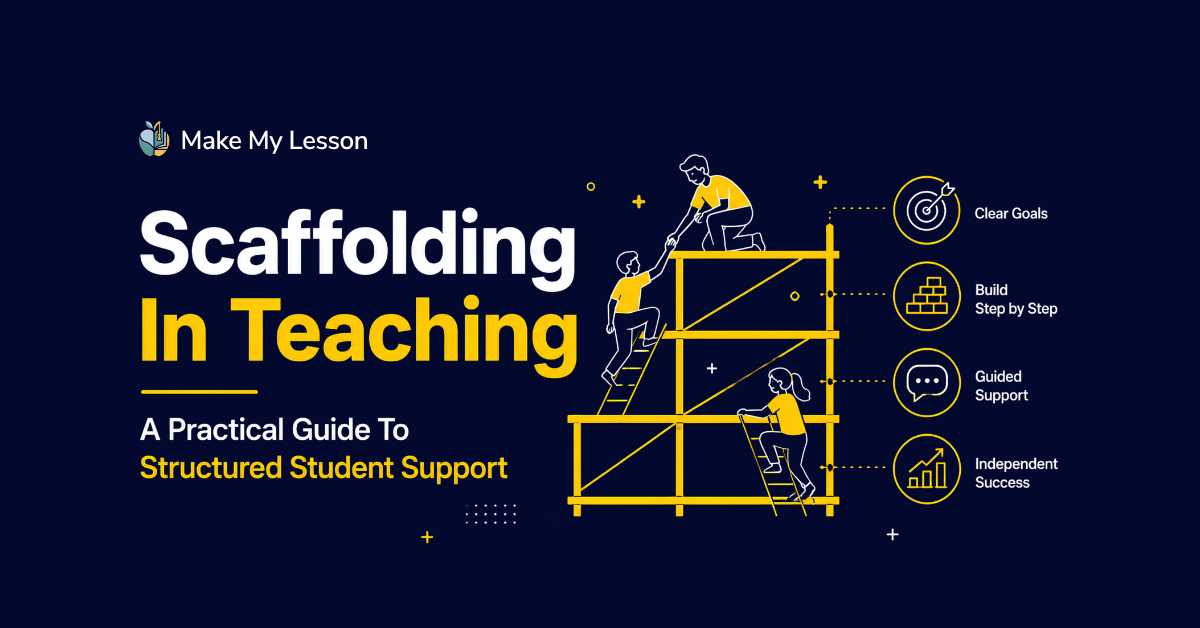
Scaffolding in teaching means breaking learning into manageable steps and gradually removing support as students build independence and confidence. It helps students tackle content that would otherwise be too difficult to approach on their own.
Every teacher has watched a student freeze in front of a task that's technically within their ability but feels overwhelming without the right entry point. Scaffolding in teaching solves this by breaking complex tasks into a structured sequence of manageable steps, giving students the support they need to succeed before gradually removing it. At Make My Lesson, we build lesson planning tools around this exact principle, helping teachers design scaffolded lessons quickly without sacrificing depth or rigour.
This guide explains what genuine scaffolding looks like in the classroom, common mistakes teachers make when applying it, and how the right tools can make consistent scaffolding far easier to plan for.
What Scaffolding Actually Means in the Classroom
Scaffolding is often confused with simply making a task easier. In practice, it means maintaining the same level of challenge while providing temporary structural support — worked examples, sentence starters, or guided questioning — that helps students access content they couldn't yet handle independently.
Learning support of this kind is deliberately temporary. The defining feature of effective scaffolding is that it's gradually withdrawn as students demonstrate growing competence, moving them toward independent mastery rather than permanent reliance on support structures.
Guided learning works best when it's planned in advance, not improvised in the moment. Teachers who scaffold effectively tend to map out the support structure before the lesson, anticipating where students are likely to struggle and preparing appropriate scaffolds ahead of time.
Common Scaffolding Techniques That Actually Work
Worked examples remain one of the most reliable scaffolding techniques, particularly for procedural or multi-step tasks. Showing students a fully solved example before asking them to attempt a similar problem reduces cognitive overload significantly.
Step by step teaching through chunking — breaking a large task into smaller, sequential sub-tasks — helps students build confidence incrementally rather than facing the full complexity of a task all at once. Each completed chunk becomes a small win that supports motivation.
Questioning scaffolds, such as structured prompts that guide student thinking without providing direct answers, help develop reasoning skills rather than just task completion. This technique works particularly well for open-ended or analytical tasks where there isn't a single correct procedure to follow.
Why Scaffolding Matters for Differentiated Classrooms
Classrooms rarely contain students at a single, uniform ability level. Scaffolding gives teachers a practical way to differentiate support without creating entirely separate lesson plans for different groups of students.
Students who need more support can receive additional scaffolding elements, while more confident students can move through the same core task with fewer prompts — allowing one lesson structure to flex across a range of ability levels.
This approach also supports students with additional learning needs particularly well, since scaffolding provides the structured, predictable support many of these students benefit from, without singling them out through separate materials.
Common Mistakes Teachers Make With Scaffolding
The most frequent mistake is leaving scaffolds in place too long. If support structures never get removed, students can become dependent on them rather than building genuine independent capability — defeating the actual purpose of scaffolding.
Over-scaffolding a task can also reduce it to something too simple, removing the productive struggle that's necessary for genuine learning. Effective scaffolding maintains challenge while managing complexity, rather than eliminating challenge altogether.
Some teachers apply the same scaffolding structure to every lesson regardless of content, which can become mechanical rather than responsive. Strong step by step teaching adapts scaffold type and intensity to what a specific task actually demands.
How Lesson Planning Tools Support Consistent Scaffolding
Planning scaffolded lessons well takes time — mapping out sequenced steps, preparing worked examples, and designing questioning prompts for multiple ability levels. Purpose-built lesson planning tools can significantly reduce this planning burden.
A tool that helps teachers build lesson structures around scaffolding principles by default makes it easier to apply consistently across a term, rather than only when time allows for detailed manual planning.
Templates that prompt teachers to consider chunking, worked examples, and gradual release of responsibility at the planning stage help embed scaffolding as a standard part of lesson design, not an occasional add-on.
How Make My Lesson Supports Scaffolded Lesson Design
Make My Lesson is built around evidence-based teaching practices, including structured scaffolding support built directly into our lesson planning workflows, helping teachers design well-sequenced lessons more efficiently.
Our platform prompts teachers to consider gradual release of responsibility at each stage of lesson design, making it easier to build scaffolding into everyday planning rather than treating it as extra work reserved for special lessons.
We work with practising educators to keep our approach grounded in real classroom application, ensuring the scaffolding guidance built into our tools reflects what genuinely works with real students, not just education theory in isolation.
Final Thoughts
Scaffolding in teaching gives students the structured support they need to tackle challenging content, while building toward genuine independence rather than long-term dependence. The teachers who apply it most effectively plan it deliberately, adjust it to the task, and know when to gradually step back.
Want to build scaffolded lessons faster without sacrificing depth? Try Make My Lesson today and see how structured planning tools can support better lesson design across your classroom.
Frequently Asked Questions
What is the main purpose of scaffolding in teaching?
Scaffolding provides temporary, structured support that helps students access challenging content, with the goal of gradually building independent mastery rather than long-term reliance on support.
How is scaffolding different from simply making a task easier?
Scaffolding maintains the same level of challenge while adding temporary structural support, whereas simplifying a task reduces the challenge itself, which can limit genuine learning.
What are examples of common scaffolding techniques?
Common step by step teaching techniques include worked examples, task chunking, sentence starters, and structured questioning prompts that guide student thinking without giving direct answers.
How do teachers know when to remove scaffolding support?
Scaffolds should be gradually withdrawn as students demonstrate growing competence and confidence, typically signalled by fewer errors or reduced need for prompting during guided practice.
Can lesson planning tools help with scaffolding design?
Yes, purpose-built tools like Make My Lesson can prompt teachers to build chunking, worked examples, and gradual release directly into lesson plans, reducing the manual planning burden involved in effective scaffolding.