Teacher Wellbeing
The methods of teaching that produce the strongest learning outcomes have been studied, debated, and refined for decades in educational research — and there is now a strong evidence base that separates effective teaching methods from those that feel productive but produce limited results. The challenge for classroom teachers is not identifying which methods work. Most experienced educators know the research. The challenge is implementing those methods consistently, across every lesson, across every subject, across an entire school year — while managing the full scope of professional demands that teaching in America involves.
This blog examines the teaching strategies that research most consistently supports, explains why they are effective, and shows how Make My Lesson helps teachers implement them systematically rather than sporadically.
The Methods of Teaching With the Strongest Evidence Base
Educational researcher John Hattie's Visible Learning synthesis — one of the most comprehensive meta-analyses of educational research ever conducted, covering more than 1,400 meta-analyses and 300 million students — identifies a set of instructional approaches with consistently high effect sizes. These are not theoretical models — they are practices with documented, replicated impact on student achievement.
1. Direct Instruction
Direct instruction is among the most consistently effective classroom methods in Hattie's research — with an effect size of 0.60, well above the 0.40 threshold that represents meaningful learning impact. Contrary to its reputation in some educational circles as passive or teacher-centered, effective direct instruction is highly structured, explicitly teaches the skills and knowledge students need, provides worked examples, checks for understanding frequently, and scaffolds student practice carefully. It is teacher-led but cognitively active for students.
2. Feedback
High-quality, specific feedback has one of the largest effect sizes of any teaching strategy — 0.70 in Hattie's research. The key qualifiers are high-quality and specific: feedback that tells students where they are relative to where they need to be, what specifically needs to change, and how to change it produces measurable learning gains. Generic feedback ('well done' or 'needs improvement') produces minimal impact. Formative assessment tools that reveal exactly which skills students have and haven't developed are the foundation of the feedback that actually moves learning.
3. Spaced Practice and Retrieval
When teachers build regular opportunities for students to retrieve previously learned material — through warm-up questions, low-stakes quizzes, exit tickets, and discussion prompts that draw on prior lessons — they are implementing one of the most evidence-backed approaches in learning science. Spaced retrieval practice consistently outperforms blocked practice (covering a topic intensively before moving on) for long-term retention. Teachers who build retrieval into their lesson structure rather than reserving it for test review consistently produce better end-of-year outcomes.
4. Collaborative Learning
Well-structured collaborative learning — tasks where students work together to achieve a shared learning goal, with individual accountability built in — produces significant learning gains across subjects and grade levels. The critical word is well-structured: group tasks where individual accountability is absent tend to produce unequal contributions and limited learning for passive participants. Think-pair-share, jigsaw activities, collaborative problem solving with individual writeups, and structured academic controversy are examples of collaborative methods that maintain individual accountability while leveraging the cognitive benefits of peer discussion.
5. Differentiated Instruction
Differentiated instruction — adjusting the content, process, or product of learning based on students' readiness, interests, and learning profiles — is both one of the most recommended and one of the most time-consuming effective teaching methods. When done well, it ensures that every student in the room is working in their zone of proximal development — challenged but not overwhelmed. When done poorly — or skipped due to time constraints — the students at the extremes of the class's achievement range are consistently underserved.
The Consistency Problem: Why Knowing These Methods Isn't Enough
Every experienced teacher reading this section already knows these teaching strategies. The research is well-publicized. What is less well-publicized is the implementation gap — the distance between knowing a method is effective and implementing it consistently across every lesson of a school year.
When a teacher is tired, pressed for time, managing unexpected classroom challenges, or simply stretched across too many planning tasks simultaneously, instructional design quality tends to decline. The lesson hook gets cut. The differentiation strategies don't get built. The formative assessment becomes a show of hands rather than a written check. The methods get applied inconsistently — which means their benefits accrue inconsistently, and the students who most need consistent implementation of evidence-based teaching are the ones who are least likely to get it.
How Make My Lesson Makes Effective Teaching Methods the Default
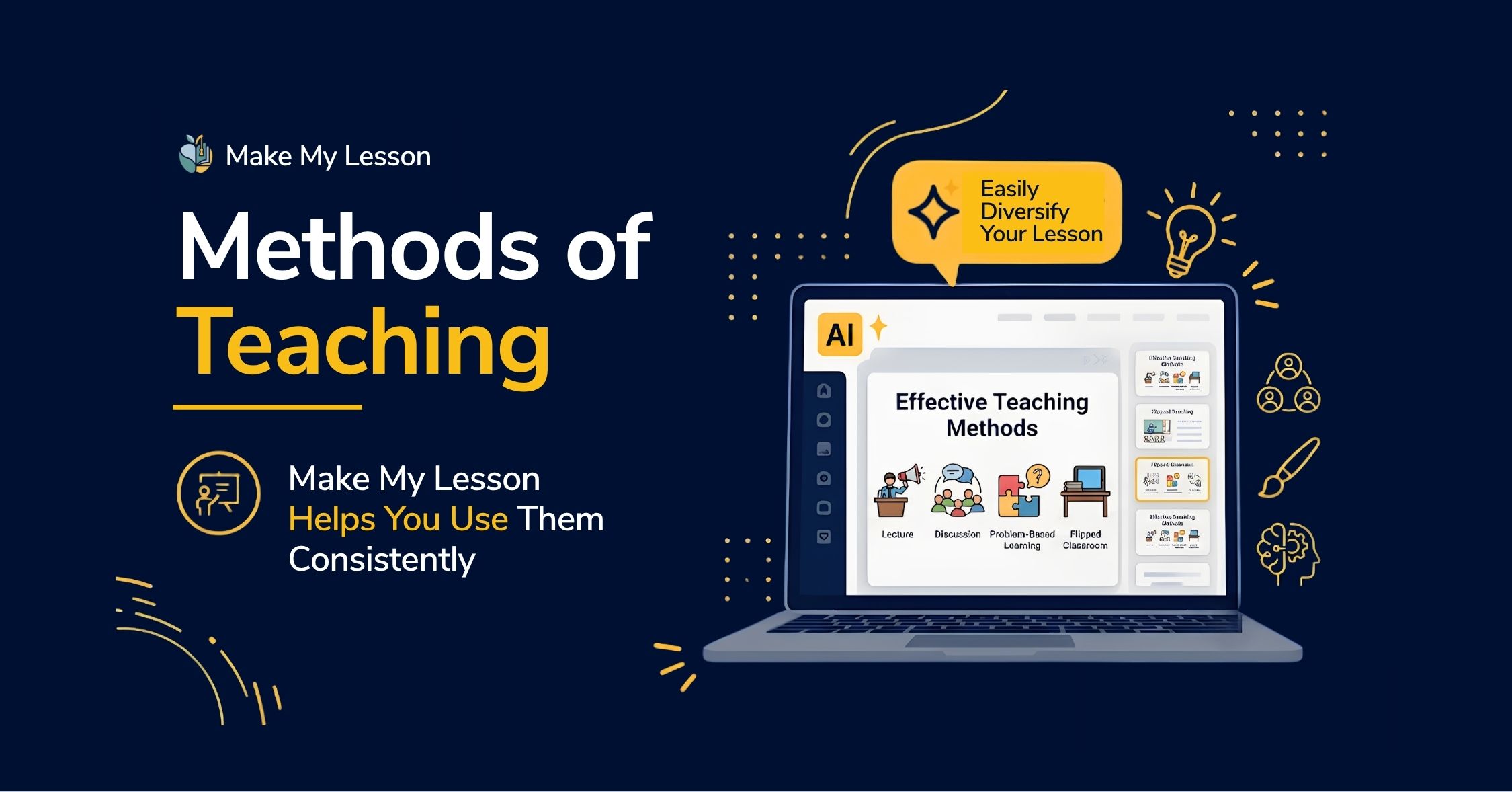
Make My Lesson builds the effective teaching methods described above into the structure of every lesson plan it generates. This is not a stylistic choice — it's an intentional design decision based on the research on what produces learning.
Every generated lesson plan includes a structured direct instruction sequence with an explicit connection between prior knowledge and new content, built-in check-for-understanding moments throughout the lesson (not just at the end), differentiation strategies for the range of learners in the class embedded in the instructional activities, collaborative or discussion tasks that maintain individual accountability, and aligned formative assessment that gives the teacher specific feedback data about student understanding. These are not optional extras that time pressure might cut — they are built into the foundation of every plan the platform produces.
The result is that teachers who use Make My Lesson consistently are implementing evidence-based teaching methods consistently — not because they've changed their professional values or increased their planning time, but because the tool they're using builds those methods into every lesson by default.
Frequently Asked Questions
What are the most effective methods of teaching?
Based on large-scale educational research — particularly Hattie's Visible Learning meta-analysis — the teaching methods with the strongest and most consistent evidence of improving student outcomes include: direct instruction with frequent checking for understanding; high-quality, specific feedback; spaced retrieval practice; well-structured collaborative learning with individual accountability; and differentiated instruction that adapts to students' readiness and learning profiles. All of these methods are built into the lesson plans Make My Lesson generates.
What is the difference between teaching methods and teaching strategies?
Teaching methods are the broad approaches to instruction that define how content is delivered — direct instruction, inquiry-based learning, cooperative learning, problem-based learning, and so on. Teaching strategies are the specific techniques used within or across methods — think-pair-share, exit tickets, cold calling, worked examples, graphic organizers. Methods set the instructional framework; strategies are the specific tools used within that framework. Effective teachers typically combine methods and strategies deliberately based on the learning objective and their students' needs.
What are the most common classroom methods used in American schools?
The most common classroom methods in American K–12 schools include direct instruction (teacher-led explicit teaching of skills and content), cooperative or collaborative learning (student group tasks with shared goals), inquiry-based learning (student-led investigation of questions or problems), project-based learning (extended tasks producing real-world products or outcomes), and differentiated instruction (adapting content, process, or product to student readiness and learning profiles). Research supports different methods for different types of learning goals — the most effective teachers use a repertoire rather than relying on a single approach.
How does Make My Lesson incorporate effective teaching methods?
Make My Lesson incorporates effective teaching methods into every lesson plan it generates by including: a structured direct instruction sequence; explicit connections between prior knowledge and new content; built-in checking-for-understanding moments throughout the lesson; differentiation strategies for diverse learner profiles; collaborative discussion tasks; and a formative assessment aligned to the lesson's objective. These elements are built into the lesson structure by default — not as add-ons that time pressure might eliminate — ensuring that the methods with the strongest evidence base are consistently present in the lessons teachers deliver.
Why do some teaching methods work better than others?
Teaching methods work better or worse depending on how well they align with how human memory and learning operate. Methods that require active cognitive engagement — retrieval practice, elaboration, explanation, application — consistently outperform methods that involve passive exposure — listening, reading, watching. The reason is that memory is formed through effortful processing: the cognitive work of retrieving, connecting, and applying knowledge creates stronger, more durable memory traces than passive reception of information. Methods built around this principle consistently produce better learning outcomes than those built around content delivery alone.