Teacher Wellbeing
Gamification gets reduced to a leaderboard and a sticker chart more often than it should. A teacher hears the word, pictures a point system bolted onto an existing worksheet, and either dismisses it as gimmicky or spends a Sunday evening trying to build something more substantial than that. Neither outcome reflects what gamification is actually capable of doing in a classroom, and the gap between the two usually comes down to time, not interest.
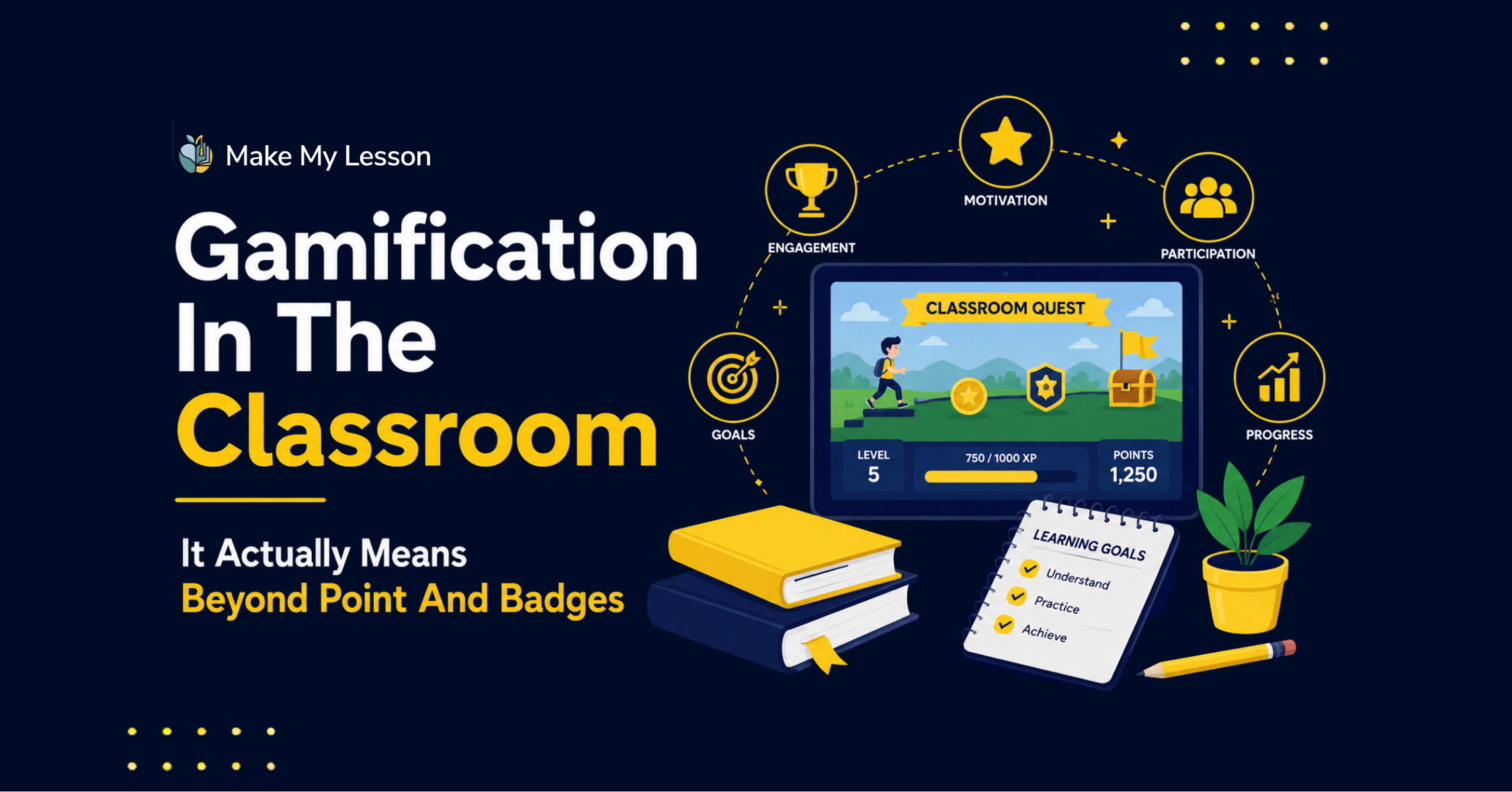
Done well, gamification borrows specific design principles from games, like clear goals, immediate feedback, and a sense of progress, and applies them to how a lesson is structured, not just how it’s scored. Done poorly, it’s decoration: a badge for finishing a worksheet that would have gotten finished anyway. This guide breaks down what separates the two, with classroom-ready examples and an honest look at the planning time gamification actually requires.
What Is Gamification in Education?
Gamification in education means applying game-design elements, such as challenges, levels, immediate feedback, and visible progress, to non-game learning activities in order to increase engagement and motivation. It is not the same as game-based learning, which uses actual games as the instructional vehicle. Gamification takes an existing lesson, activity, or assessment and restructures how students interact with it, often by introducing choice, competition, collaboration, or a sense of advancement.
The mechanism behind why this works isn’t mysterious. Students engage differently with a task framed as a challenge to overcome than with one framed as an assignment to complete, even when the underlying content is identical. A worksheet on solving for x becomes a different experience when it’s reframed as unlocking the next stage of a problem set, with immediate feedback on whether each answer is correct before moving forward.
Where Gamification Actually Works, and Where It Falls Flat
Gamification activities tend to succeed when they reinforce content that benefits from repetition, practice, or incremental mastery, such as vocabulary, math fluency, grammar rules, or fact recall. A points-based review game before a unit test gives students low-stakes practice with immediate feedback, which tends to outperform a quiet worksheet review for keeping attention through the last ten minutes of class.
Gamification examples in the classroom that tend to fall flat usually share one problem: the game layer is disconnected from the learning objective. A trivia-style point system that rewards speed over accuracy can train students to guess quickly rather than think carefully, which undermines the actual goal of the lesson. Similarly, a leaderboard with no path for lower-performing students to catch up tends to demotivate the students who need engagement the most, rather than motivating them.
The strongest gamified lesson plans tie the game mechanic directly to the content’s structure. A few patterns that hold up across grade levels and subjects:
Progressive unlocking, where students must demonstrate mastery of one concept before accessing the next, mirrors how skill-based games structure difficulty
Team-based challenges that require collaboration on a shared goal, rather than individual competition, support struggling students instead of isolating them
Immediate feedback loops, where students know within seconds whether an answer is correct, keep momentum without requiring constant teacher intervention
Narrative framing, where a unit is structured around a storyline or mission, gives context to why a sequence of tasks matters
Why Teachers Often Skip Gamification, Even When They Want to Use It
The honest reason most teachers don’t build gamified lesson plans more often isn’t lack of interest. It’s that designing a coherent point system, tiered challenges, and feedback structure on top of an already-planned lesson takes real additional time, on top of grading, parent communication, and the rest of a Sunday evening lesson-planning routine. A single gamified review activity, built well, can take an hour or more to design from scratch, especially when it needs to align with a specific standard and work for a mixed-ability classroom.
This is the actual barrier, and it’s worth naming directly rather than treating gamification as something teachers simply haven’t gotten around to trying. The idea is rarely the hard part. The hard part is translating that idea into a structured activity, with clear rules, scoring, and differentiated entry points, inside a planning window that’s already stretched thin.
How Make My Lesson Builds Gamification Into the Planning Process
Make My Lesson is built to take that planning burden off the table without removing the teacher’s control over the design. A teacher entering a topic, grade level, and standard can generate a complete lesson plan and request a gamified activity, such as a tiered challenge set or team-based review game, built around that exact content rather than a generic template. What might take an hour to build manually, including writing the rules, sequencing the difficulty levels, and aligning it to a Common Core, NGSS, TEKS, or state-specific standard, can be generated in a fraction of that time and then edited before class.
A middle school math teacher covering linear equations, for example, can generate a points-based problem set with increasing difficulty tiers, a matching exit ticket, and a differentiated version for students who need additional scaffolding, all built around the same lesson objective. Because Make My Lesson also generates worksheets, presentation slides, and assessments from the same input, the gamified activity fits into a complete lesson rather than existing as a standalone add-on disconnected from everything else being taught that day.
This matters because gamification works best as part of a coherent lesson, not as an isolated game bolted onto unrelated material. A teacher who can generate the lesson plan, the gamified practice activity, and a formative assessment from the same starting input is far more likely to use gamification consistently, rather than treating it as a special-occasion activity reserved for days with extra prep time.
Frequently Asked Questions
What is gamification in education?
Gamification in education is the practice of applying game-design elements, such as challenges, levels, points, and immediate feedback, to traditional learning activities in order to increase student engagement and motivation. It differs from game-based learning, which uses actual games as the primary teaching method. Instead, gamification restructures how students interact with existing content, often by adding a sense of progress, competition, or collaborative challenge.
How does gamification actually work to improve learning?
Gamification works by reframing a learning task as a challenge with clear goals and immediate feedback, which tends to increase sustained attention and motivation compared to a standard assignment. Immediate feedback lets students correct mistakes quickly rather than repeating an error across an entire assignment. The effect is strongest with content that benefits from repetition and incremental mastery, such as vocabulary, math fluency, or fact-based review.
Who should use gamification activities in the classroom?
Gamification activities work across grade levels and subjects, but they’re particularly effective for elementary and middle school review sessions, language acquisition, math fact fluency, and any content involving repeated practice. Teachers managing mixed-ability classrooms often find that team-based gamification, rather than individual leaderboards, supports a wider range of students without isolating those who are still building confidence. High school teachers tend to use gamification most successfully for test review and skill-building units rather than entirely new content introduction.
What is the difference between gamification and game-based learning?
Gamification applies game-like elements, such as points, levels, and feedback loops, to an existing non-game activity, like a worksheet or review session. Game-based learning uses an actual game, whether digital or physical, as the primary vehicle for teaching the content itself. The two are often used together, but gamification is generally easier to layer onto an existing lesson plan without rebuilding the entire activity from scratch.
How does Make My Lesson help teachers build gamified lesson plans?
Make My Lesson generates gamified activities, such as tiered challenge sets or team-based review games, directly from a teacher’s topic, grade level, and standard, removing the hour or more of manual design time these activities usually require. Because it also generates the matching lesson plan, worksheets, presentation slides, and assessments from the same input, the gamified activity fits naturally into a complete lesson rather than functioning as a disconnected add-on. This makes it realistic for teachers to use gamification consistently, rather than saving it for days with extra planning time available.