Curriculum Guides
Blended learning is one of the most widely discussed approaches in modern education, and one of the most inconsistently implemented. Teachers are told that combining digital instruction with face-to-face learning improves engagement, supports differentiation, and prepares students for a technology-integrated world all of which is true. What they are rarely told is how to design a coherent blended learning lesson plan in a working week that already holds thirty hours of teaching, marking, meetings, and administrative requirements. The gap between the theory of blended learning and its practical execution in real classrooms is significant, and it falls almost entirely on teachers to bridge it.
This is not a small ask. John Hattie's Visible Learning research identifies feedback and direct instruction as two of the highest-impact influences on student achievement, with effect sizes of 0.70 and 0.60 respectively. Blended learning, done well, allows teachers to maximise both — using technology for initial content delivery and independent practice, then reserving face-to-face time for the high-value feedback and guided discussion that only a skilled teacher can provide. But designing those two components to work together coherently requires careful planning, and careful planning takes time that most teachers do not have.
This blog is a practical guide to blended learning for classroom teachers — not a theoretical overview, but a working framework for designing blended learning lesson plans that actually function in real school environments.
What Blended Learning Actually Means in a Classroom Context
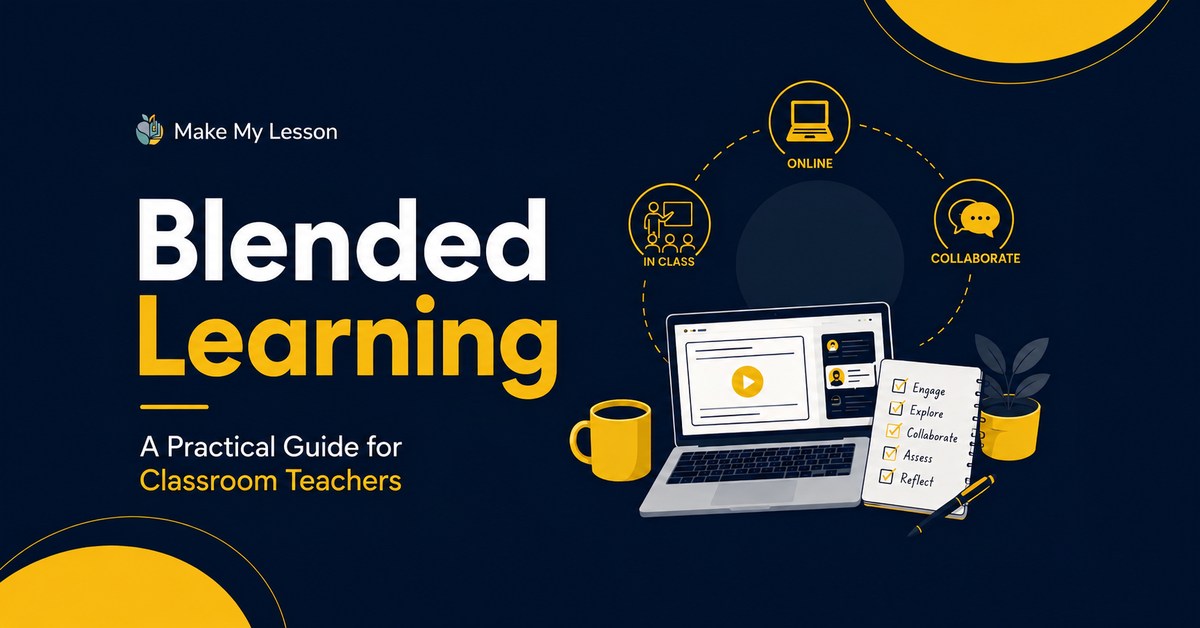
The term blended learning gets applied to a wide range of instructional arrangements, not all of them meaningful. A teacher who occasionally shows a YouTube video during a lesson is not practising blended learning. The defining feature of true blended learning is intentional integration: digital and in-person components are designed to complement each other, with students exercising some degree of control over the pace, path, or place of their learning.
The four most commonly used blended learning models in K-12 education are the rotation model, the flex model, the a la carte model, and the enriched virtual model. For most classroom teachers working within a traditional school structure, the rotation model — and specifically the station rotation or flipped classroom variants — is the most practical. In station rotation, students move through three or four learning stations during a class period, with at least one station being technology-based. In the flipped model, students access instructional content digitally at home and use class time for application and discussion.
What these models share is a deliberate division of instructional labour: technology handles content delivery and practice at scale, while the teacher focuses their direct time on the high-impact activities that require human judgment — questioning, feedback, guided practice, and addressing misconceptions. Getting this division right is what separates a genuine blended learning strategy from a lesson that happens to include a device.
The Real Challenge: Designing Blended Learning Lesson Plans That Cohere
The planning challenge in blended learning is not identifying the right model — most experienced teachers can articulate what they are trying to achieve. The challenge is execution: creating lesson plans where the digital and in-person components are genuinely integrated rather than parallel, where the digital activities are pedagogically purposeful rather than just screen time, and where differentiation is embedded from the start rather than bolted on for compliance.
A well-designed blended learning lesson plan specifies what students will do digitally, what they will do face-to-face, how the two connect, what the teacher will be doing while students work through digital tasks, and how the lesson accommodates different learners. Writing all of that out — for every lesson, across multiple subjects and class groups — is what makes blended learning strategies demanding to sustain. Teachers who begin the school year with strong blended learning designs often simplify or abandon them by midterm not because the approach failed but because the planning burden became unsustainable.
This is the problem worth solving. Blended learning has genuine evidence behind it. The failure point is not instructional design — it is the planning infrastructure that enables teachers to implement those designs consistently without burning out.
Practical Blended Learning Strategies That Work in Real Classrooms
For teachers designing their first blended unit or refining an existing approach, a few structural principles make a significant difference. The first is to start with the learning objective and work backward. The question is not 'how can I use technology in this lesson?' but 'what do I want students to know or be able to do, and which part of that is best delivered digitally versus in person?' When that question drives design, technology becomes purposeful rather than decorative.
The second principle is to use digital components for activities that benefit from self-pacing — instructional video, practice exercises, reading, and formative quizzes. These are activities where different students naturally work at different speeds, and technology can accommodate that variation in a way that a whole-class format cannot. Face-to-face time is then reserved for discussion, application, problem-solving in groups, and the kind of responsive teaching that requires a teacher to read the room in real time.
Differentiation is the third structural principle. Effective blended learning lesson plans build in scaffolded versions of digital tasks for students who need additional support, extended tasks for students who move through content quickly, and clear checkpoints that allow the teacher to identify who needs direct intervention before the class period ends. Embedding differentiation into the digital component rather than managing it manually during class time is what makes blended learning scalable for a single teacher managing thirty students.
How Make My Lesson Simplifies Blended Learning Planning
Make My Lesson is an AI-powered lesson planning platform built specifically for teachers, and it addresses the blended learning planning challenge directly. A teacher inputs their subject, grade level, learning objectives, and curriculum framework — Common Core, NGSS, TEKS, or other state standards — and Make My Lesson generates a complete, curriculum-aligned lesson plan in minutes. That includes differentiated materials for ELL students, below-grade-level learners, and advanced students, as well as classroom presentation slides and worksheets that can be used in digital or print formats.
For blended learning specifically, the time savings are significant. A blended learning lesson plan that would typically take sixty minutes or more to design from scratch takes under ten minutes with Make My Lesson. Over a school year, that returns more than 150 hours to teachers — time that can be spent on the high-impact instructional work that no planning tool can replicate. The platform is available on both web and mobile, so teachers can refine plans between periods or generate new materials without being tied to a desk. Blended learning works when teachers have the capacity to implement it well; Make My Lesson builds that capacity.
Frequently Asked Questions
What is blended learning?
Blended learning is an instructional approach that intentionally combines face-to-face teaching with online or digital learning components, designed so that each reinforces the other. It is not simply using technology during a lesson — the defining feature is integration, where students exercise some control over the time, pace, or path of their learning through the digital component, while the teacher focuses face-to-face time on high-impact instructional activities. The most common models used in K-12 classrooms include station rotation, flipped classroom, and flex models.
What are the most effective blended learning strategies for classroom teachers?
The most effective blended learning strategies start with clear learning objectives and assign the digital and in-person components based on which format best serves each type of learning activity. Digital tools work best for self-paced content delivery, independent practice, and formative assessment. Face-to-face time is most valuable for feedback, guided discussion, collaborative problem-solving, and responsive teaching. Embedding differentiated tasks within the digital component — rather than managing differentiation manually — makes blended learning sustainable for teachers working with diverse classrooms.
How do I write a blended learning lesson plan?
A blended learning lesson plan should begin with the learning objective, then specify what students will do in each component — digital and in-person — and explain how the two connect. The plan should include what technology or platform students will use, what the teacher will be doing during the digital phase, how the lesson accommodates learners at different levels, and how student progress will be assessed. The most common failure in blended lesson planning is designing the two components independently rather than as a unified instructional sequence.
What makes blended learning lesson plans difficult to sustain?
The primary challenge is planning time. A well-designed blended lesson requires more upfront design work than a traditional lesson — specifying digital tasks, creating or curating digital content, building in differentiation, and ensuring the two components cohere. Teachers working a full schedule rarely have the sustained planning time this demands. The result is that blended learning approaches are often simplified or abandoned mid-year, not because they fail instructionally but because the planning burden is unsustainable without appropriate tools or support.
How does Make My Lesson support blended learning?
Make My Lesson generates complete, curriculum-aligned lesson plans from teacher inputs in minutes, including differentiated materials, worksheets, and presentation slides. For teachers implementing blended learning, this dramatically reduces the time required to design each lesson — from over an hour to under ten minutes per plan. The platform supports all subjects, all grade levels, and multiple US curriculum frameworks, meaning teachers can use it across their entire teaching load rather than for a single course. It is available on web and mobile, giving teachers flexibility in when and where they plan.