Lesson Planning
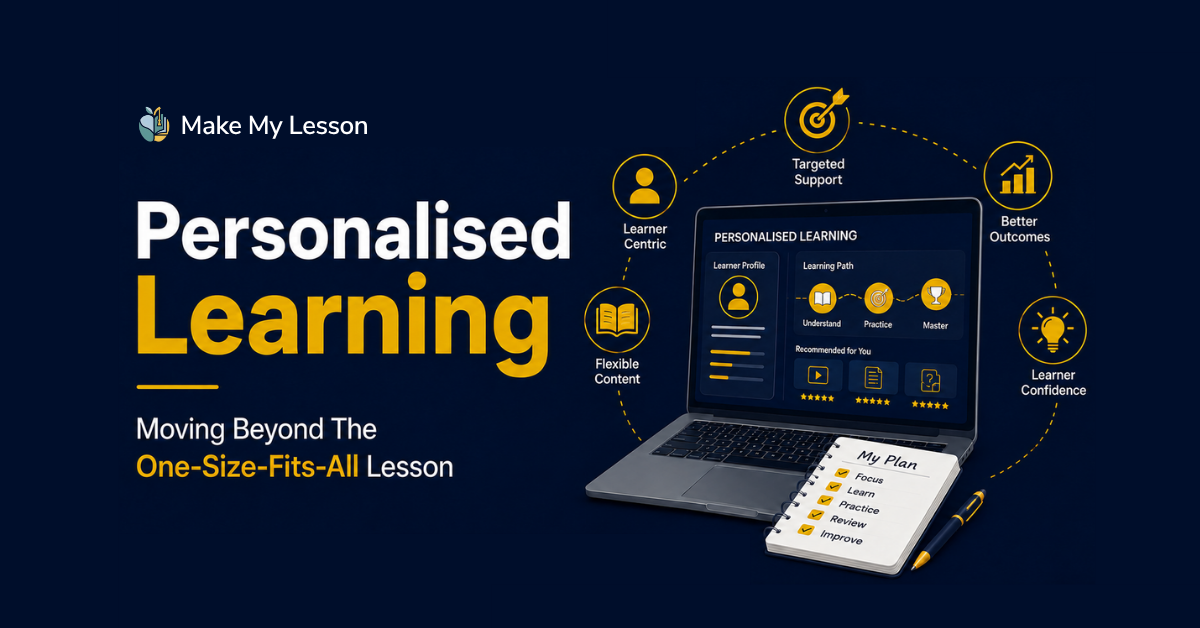
Personalised learning means adapting content, pace, and teaching approach to match individual student needs, rather than delivering identical instruction to an entire class regardless of readiness or learning style. It aims to meet students where they actually are, not where a generic curriculum timeline assumes they should be.
Every classroom contains students at genuinely different starting points, yet traditional lesson delivery often assumes a single, uniform pace works for everyone. Personalised learning challenges this assumption directly, adapting content and instructional approach to match where individual students actually are. At Make My Lesson, we build lesson planning tools around this principle, helping teachers implement personalised learning strategies without requiring an entirely separate lesson plan for every student.
This guide explains what genuine personalised learning looks like in practice, common misconceptions that undermine it, and how teachers can realistically implement it within normal classroom constraints.
What Personalised Learning Actually Means
Personalised learning strategies adjust pace, content difficulty, and sometimes instructional method based on individual student data — not just student preference or interest, which is a common but incomplete interpretation of the concept.
This differs meaningfully from simple differentiation, which typically means offering a small number of variations for different ability groups. Genuine personalisation responds more granularly to individual performance patterns, ideally in an ongoing way throughout a unit of work.
It's also worth being clear about what personalised learning isn't. It doesn't mean students working entirely independently with no teacher guidance — the teacher's role in identifying needs and structuring appropriate support remains central throughout.
Personalised Learning Examples That Work in Real Classrooms
Flexible grouping based on current performance, rather than fixed ability tracking, allows students to move between groups as their understanding of a specific topic develops, rather than being locked into a single trajectory for an entire term.
Choice-based tasks that let students demonstrate understanding through different formats — written response, presentation, practical application — can accommodate different strengths while still assessing the same underlying learning objective.
Adaptive practice tools that adjust question difficulty based on individual performance give students the right level of challenge automatically, without requiring a teacher to manually track and adjust for each student in real time.
Practical Personalised Learning Activities for Everyday Lessons
Tiered tasks — the same core learning objective presented at different levels of complexity or scaffolding — let a teacher run one lesson that still meets students at genuinely different starting points.
Student-led goal setting, where learners identify specific areas they want to improve based on recent assessment feedback, builds ownership over the learning process while still operating within teacher-guided structure.
Regular, low-stakes check-ins that inform next steps, rather than waiting for formal assessment points, allow personalisation to happen continuously rather than only at major curriculum checkpoints.
Why Personalised Learning Often Fails in Practice
The most common failure point is treating personalisation as a one-time setup rather than an ongoing process. Student needs shift throughout a term, and a personalisation plan created at the start of a unit quickly becomes outdated without regular review.
Time constraints also derail good intentions. Without tools that streamline tracking and content adaptation, genuinely personalised instruction can become unsustainable for a teacher managing a full class load across multiple subjects or year groups.
Some approaches also confuse personalisation with simply lowering expectations for struggling students, which undermines the actual goal — meeting students at their current level while still maintaining appropriately high expectations for growth.
How Lesson Planning Tools Make Personalisation Sustainable
Planning tools that help teachers build tiered tasks and flexible groupings directly into lesson templates reduce the manual burden that often makes personalised learning strategies feel unsustainable over a full term.
Tools that track individual student performance patterns over time help teachers identify when personalisation adjustments are actually needed, rather than relying purely on memory or informal observation.
At Make My Lesson, our platform is designed to make personalised learning activities part of standard lesson planning, not an additional layer of separate work competing for a teacher's already limited time.
Want to build personalised learning into your everyday lesson planning without adding extra hours to your week? Try Make My Lesson today and see how structured tools can make real personalisation sustainable.
Frequently Asked Questions
What is the difference between personalised learning and differentiation?
Differentiation typically offers a small number of fixed variations for different ability groups, while personalised learning responds more granularly and continuously to individual student performance data.
What are some simple personalised learning examples for a busy classroom?
Tiered tasks with the same learning objective at different complexity levels, flexible grouping based on current performance, and adaptive practice tools are all practical starting points.
Does personalised learning mean lowering expectations for some students?
No. Genuine personalised learning strategies meet students at their current level while maintaining high expectations for growth, rather than reducing the rigour of learning goals.
How can teachers make personalised learning activities manageable?
Lesson planning tools that build tiered tasks and flexible grouping directly into templates significantly reduce the manual tracking burden that often makes personalisation feel unsustainable.
How often should personalisation plans be reviewed?
Regularly, ideally through ongoing low-stakes check-ins rather than only at major assessment points, since student needs shift throughout a term and outdated plans lose their value quickly.