Teacher Wellbeing
Number sense activities work best when they are chosen because they move learning forward, not because a lesson needs a filler task. The first question is always: what should students know, notice, practise or explain by the end of this activity? When the purpose is clear, timing, grouping and teacher prompts become much easier to decide.
A teacher can build number sense activities into a wider curriculum-aligned lesson rather than planning the activity in isolation. Make My Lesson generates a lesson sequence from topic, year level and curriculum context, which makes it easier to connect the warm-up or collaborative task to learning intentions, core teaching and assessment.
Use a Simple Instructional Sequence
For flexible thinking about quantity, relationships and operations, a useful sequence is explain the goal, model what successful participation looks like, give students a short guided attempt, then move into independent or collaborative practice. The activity should have a clear start and stop point so discussion does not expand without purpose.
The Australian Education Research Organisation's Australian Curriculum guidance supports clear explanation, modelling, guided practice and checking for understanding. That does not mean every lesson must look identical; it means students should know what they are practising and what quality looks like before they are asked to perform independently.
Eight Classroom Activities to Try
The following ideas are deliberately low-preparation. Reuse the routine and change the content. Familiar structures reduce instruction time and let students focus on the learning rather than on figuring out a new game every lesson.
1. Number talk: show one calculation and collect several mental strategies without immediately naming a preferred method.
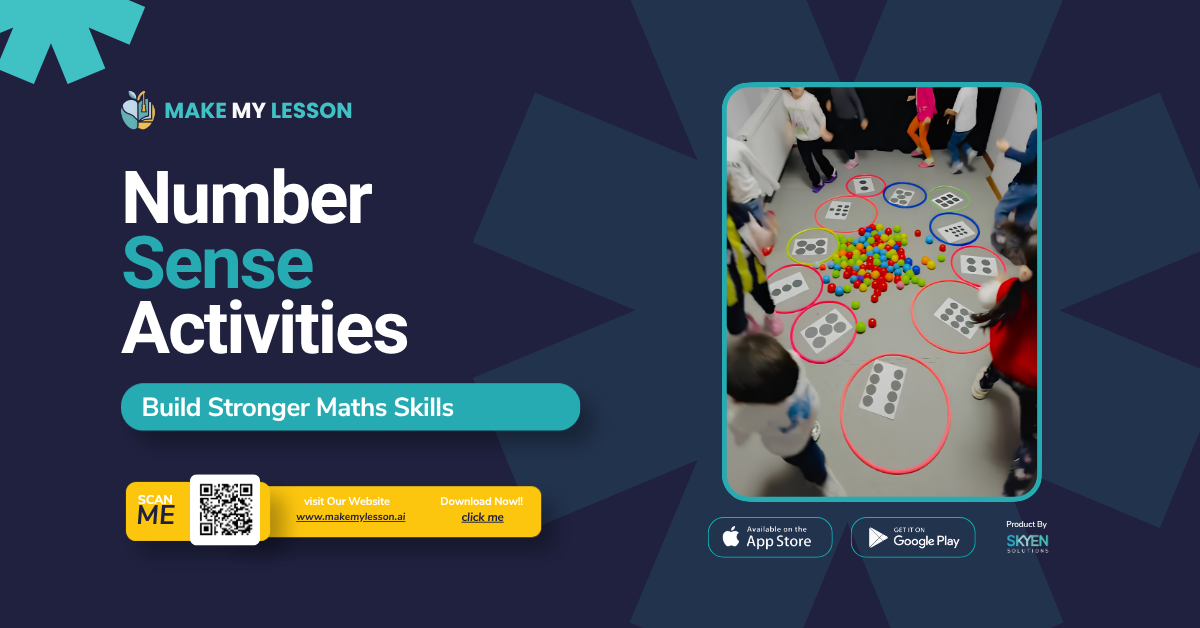
2. Dot image flash: display a dot pattern briefly and ask students how they saw the quantity without counting one by one.
3. Make the target: give a target number and a set of digits or operations; students create several valid expressions.
4. Estimate then calculate: students make a reasoned estimate before solving and compare the final result with the estimate.
5. Which is closer?: compare two numbers, fractions or expressions with a benchmark such as 1, 100 or 1,000.
6. True or false equation: present an equality and ask students to prove or disprove it using more than one representation.
7. Open number line: students place values on a blank line and explain the benchmarks that guided their position.
8. Same number, different forms: represent one quantity with words, materials, expanded notation, equations and diagrams.
Differentiate the Same Activity Instead of Building Three Lessons
Differentiation does not always require separate worksheets. Keep the shared learning goal, then vary the support, complexity or expected response. Some students may use a sentence stem, visual, manipulatives or a worked example; others may justify, generalise, compare methods or create a new example.
Make My Lesson's teaching methods guide can help teachers choose a structure such as explicit teaching, cooperative learning or inquiry according to the lesson goal. The method should serve the content and the learners rather than becoming the objective itself.
Use the Activity as Formative Assessment
Build one observable check into the task. Listen for a specific explanation, scan mini responses, ask students to justify a choice or use an exit question that mirrors the learning intention. The point is not to grade every contribution. It is to decide what happens next.
When a quick check shows that students are ready, move on. When it reveals a shared misconception, reteach before adding difficulty. The Make My Lesson test generator can produce a connected exit ticket, practice worksheet or assessment with a mark scheme, but teachers should still select the question type that gives the most useful evidence.
Keep Classroom Management Built Into the Design
Good activities make the expected behaviour obvious. Decide group size, materials, voice level, movement rules, response format and the signal that ends the task before students begin. If the routine requires constant teacher reminders, simplify it.
For paired or group work, give each student an accountable role. This can be as simple as first speaker, evidence checker, recorder and reporter. Rotate roles so the same confident students do not dominate every discussion.
Connect the Activity to the Australian Curriculum
In Australian Curriculum Mathematics, number understanding develops through increasingly flexible use of number, place value, operations and mathematical reasoning, so activities should make student thinking visible rather than reward speed alone. Use the Australian Curriculum to confirm the relevant content and achievement expectations, then choose the activity format that gives students practice with that knowledge or skill.
Curriculum alignment is strongest when the activity, questioning and assessment all point to the same intended learning. A fun task that practises the wrong skill is still misaligned, even if students are engaged.
Plan Faster Without Losing Teacher Judgement
Make My Lesson can generate the lesson plan, slides, classroom activity and assessment as one connected teaching pack. The Make My Lesson platform is most useful when teachers treat the generated material as a strong starting point and then adjust examples, pacing, language and support for their own class.
That is also the best way to use AI in planning: reduce repetitive setup, preserve professional judgement and spend more time responding to what students actually do in the room.
Quick Planning Checklist
Name the learning intention before choosing the activity.
Keep instructions short and model one successful example.
Use one routine with multiple entry points rather than several unrelated tasks.
Build in a visible check for understanding.
Plan how every student will participate.
Stop the activity while it is still productive and connect it to the next lesson step.
Frequently Asked Questions
How long should number sense activities take?
Most classroom activities work best when the time matches the learning purpose. A short warm-up may take 5-10 minutes, while a structured collaborative task may need 15-25 minutes.
How do I differentiate number sense activities?
Keep the learning goal the same and vary scaffolds, examples, response complexity, group support or extension prompts.
Should every activity be assessed?
No. Many activities should provide formative evidence rather than a grade. Use the response to decide whether to reteach, extend or move on.
How do I keep group activities focused?
Set a specific question or product, define roles, use a visible time limit and explain what evidence of learning you will collect.
Can Make My Lesson generate classroom activities?
Yes. Make My Lesson generates curriculum-aligned lesson plans, classroom activities and assessments that teachers can edit for their own students.