Lesson Planning
A useful lesson plan template should reduce decision fatigue without reducing professional judgement. Teachers need a structure that keeps curriculum intent, classroom activity, assessment evidence and student needs connected, while remaining flexible enough for different subjects and year levels.
The strongest template is not the longest document. It captures the decisions that affect learning and leaves out administrative detail that no one uses during teaching. This guide explains the essential sections of an Australian lesson plan format and provides a planning workflow that can be reused across units.
What an Effective Lesson Plan Template Must Do
A template should make the instructional logic visible. It should show what students are expected to learn, how the teacher will know whether learning occurred and how the sequence helps students move from their current understanding toward the intended outcome.
The Australian Curriculum explains that teachers use content descriptions and achievement standards when planning, teaching, assessing and reporting. A curriculum-aligned lesson plan therefore needs both: the content description identifies the learning focus, while the achievement standard helps clarify the expected quality and progression of learning.
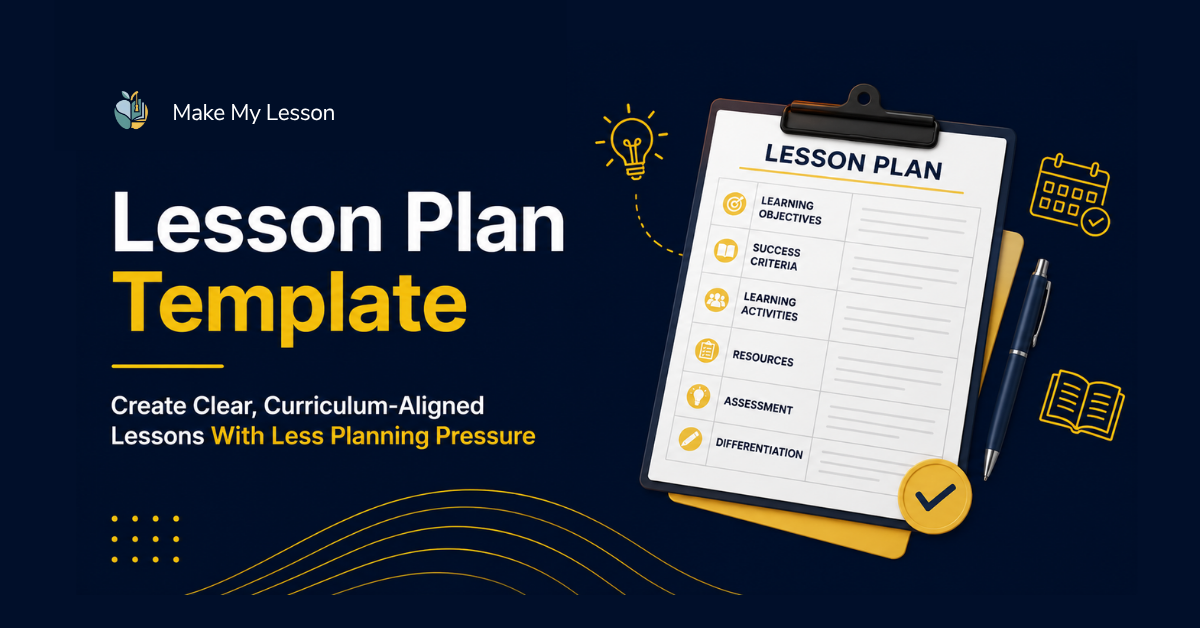
The Core Australian Lesson Plan Format
This structure works because each field supports a decision. Avoid adding sections that merely repeat the same information in different words. A template becomes burdensome when teachers spend more time completing it than using it.
Write Learning Objectives That Guide the Lesson
A learning objectives template should describe observable learning rather than the activity itself. 'Complete a worksheet' describes a task. 'Compare renewable and non-renewable energy sources using evidence' describes the intended learning.
Pair the learning intention with success criteria. Criteria should help teachers and students recognise quality without turning every lesson into a long rubric. Two or three precise indicators are often enough, such as identifying relevant evidence, explaining a relationship and using subject vocabulary accurately.
Plan the Classroom Lesson Structure Around Evidence
A practical sequence includes an entry point, explicit teaching or modelling, guided practice, independent application and a check for understanding. The exact order can change. Inquiry, workshop and project lessons may organise these phases differently, but evidence of learning still needs to be collected at useful points.
Plan the assessment before selecting every activity. Ask what evidence would show whether students reached the learning intention. This prevents engaging activities from becoming disconnected from the curriculum focus.
Include Differentiation Without Writing Three Separate Lessons
Access: vocabulary support, visuals, chunked instructions or alternative response modes
Scaffold: worked examples, prompts, sentence frames or guided practice
Extension: increased complexity, transfer to a new context or independent justification
Grouping: flexible pairs or groups based on the immediate learning need
Differentiation should preserve the learning focus while changing the support, pathway or level of challenge. It does not require lowering expectations for every student who needs assistance. The template should prompt teachers to anticipate barriers and plan responses before the lesson begins.
How Make My Lesson Can Reduce Planning Friction
Make My Lesson can generate curriculum-aligned lesson plans, worksheets, assessments, classroom slides and differentiated materials from teacher inputs. Used well, it provides a first draft that teachers can adapt to their class rather than a finished plan that should be accepted without review.
Teachers remain responsible for checking curriculum alignment, local policy, factual accuracy and suitability for learners. The platform is available on web and mobile and can support different subjects and grade levels. Its value is strongest when the teacher supplies a clear year level, learning area, curriculum focus, prior knowledge and differentiation requirements.
A Five-Minute Quality Check Before Teaching
Can the learning intention be explained in one sentence?
Do the activities produce evidence connected to the success criteria?
Is the timing realistic for this class?
Are access and extension options ready?
What will the teacher do if the check for understanding reveals a gap?
This quality check keeps the template practical. Planning is complete when the teacher can see the learning pathway and the decisions that may need to change during the lesson.
Frequently Asked Questions
What should be included in a lesson plan template?
Include curriculum alignment, learning intention, success criteria, prior knowledge, learning sequence, differentiation, assessment evidence, resources and reflection. Each section should support a real teaching decision. Remove fields that are repeatedly completed but do not influence instruction.
How is an Australian lesson plan format different?
Australian planning should connect to the relevant curriculum authority, including Australian Curriculum content descriptions and achievement standards where applicable. State and territory requirements may add specific terminology or reporting expectations. Teachers should adapt the template to their jurisdiction and school context.
How detailed should a lesson plan be?
The level of detail should match the teacher’s experience, the complexity of the lesson and the needs of the class. A new or unfamiliar sequence may require detailed prompts and examples. A routine lesson may need only the essential decisions and resources.
How do I add differentiation to a lesson plan template?
Add a field that identifies barriers, scaffolds, alternative ways to respond and extension opportunities. Keep the intended learning consistent while adjusting access and challenge. Differentiation should be specific to the class rather than a generic list.
Can Make My Lesson create a lesson plan template?
Make My Lesson can generate lesson plans and related materials from teacher inputs. Teachers should review the output for curriculum alignment, accuracy, timing and class suitability. The platform can speed up drafting while preserving the teacher’s role in professional decision-making.